
Table of Contents
- Why Comfortable Apparel for Remote Work Days Matters
- The Psychology of Getting Dressed: Comfort Meets Professionalism
- Essential WFH Wardrobe Essentials You Actually Need
- Building a Capsule Wardrobe for Remote Work
- Business Casual Remote Work Attire: Dressing for Video Calls
- Fabric Selection for Comfortable Apparel in Remote Work
- Loungewear to Elevated Basics: Transitioning Your Wardrobe
- Common Dos and Don'ts of Remote Work Attire
Last Updated: July 29, 2026
Why Comfortable Apparel for Remote Work Days Matters
Working from home requires balancing comfort with the confidence that comes from looking put-together. Comfortable apparel for remote work isn't about sacrificing professionalism; it's about supporting your productivity and mental state.
Research from American Psychological Association studies on work-life boundaries shows that how we dress creates psychological separation between personal and professional time, improving focus and reducing mental fatigue from blurred boundaries. The best approach combines breathable fabrics, strategic layering, and silhouettes designed for movement without sacrificing visual coherence.
The Psychology of Getting Dressed: Comfort Meets Professionalism
Psychologists call the effect of clothing on mental performance "enclothed cognition." When you dress in a way that aligns with your professional identity, even at home, you activate mental patterns associated with focus and competence.
Traditional office wear creates the psychological shift you need but at the cost of eight-hour discomfort. Loungewear feels comfortable but blurs the boundary between work and rest. The solution is intentional design: comfortable apparel that feels like a second skin while signaling professionalism. This means prioritizing fabrics with four-way stretch, silhouettes allowing full range of motion, and neutral color palettes that work across video calls and solo work.
Essential WFH Wardrobe Essentials You Actually Need
Build a capsule wardrobe around neutral colors and clean lines: 4-5 tops, 2-3 bottoms, and 1-2 layering pieces that all coordinate. When every piece works with every other piece, you reduce decision fatigue while ensuring you always look intentional.
Elevated Basics: Neutral Colors and Clean Lines
Elevated basics are pieces that look intentional but maintain comfort for all-day wear: structured linen blouses instead of soft cotton t-shirts, tailored joggers instead of sweatpants, and knit blazers without traditional rigidity.
Neutral colors, cream, soft gray, sage, charcoal, warm beige, create visual coherence on camera and layer effortlessly. Clean lines with minimal seaming, flat-front construction, and simplified cuts photograph better on video and create an impression of intentionality. Avoid heavy texture or busy patterns for video calls; patterns can create moiré effects and heavy textures read as less professional.
Stretch Fabrics and Breathable Materials for All-Day Comfort
The fabric you choose determines whether your clothes actually feel comfortable by hour six. Prioritize breathability, stretch, and recovery. Fabrics like cotton-blend knits, linen-cotton blends, and modal deliver this combination. Avoid 100% synthetic fabrics, which trap heat and moisture.
Four-way stretch fabrics stretch in all directions, allowing you to shift positions, lean back, and reach without feeling constrained or creating visible stress marks.
Building a Capsule Wardrobe for Remote Work
A capsule wardrobe for remote work is smaller and more flexible than a traditional office wardrobe. Build around 10-12 core pieces that all coordinate, creating roughly 45 different outfit combinations, more than enough for two weeks without repeating a complete outfit.
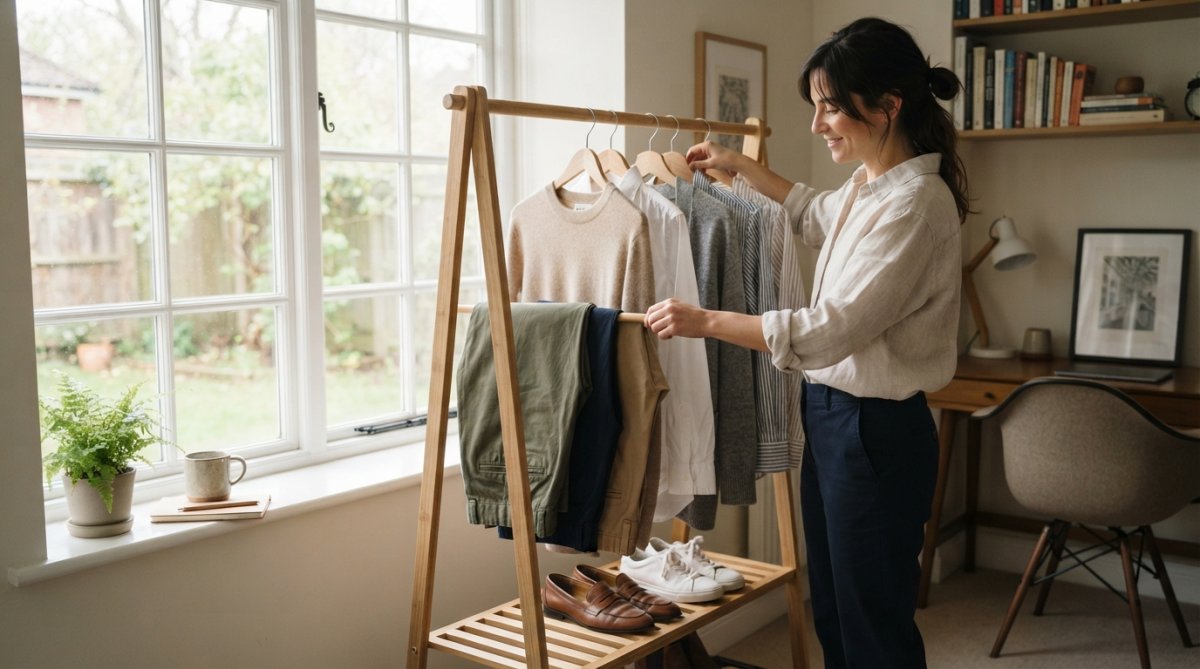
Tailored Chinos and Knit Blazers: Smart Casual Foundations
Tailored chinos split the difference between joggers and dress pants: structured enough to look intentional on camera, comfortable enough to wear for eight hours. Choose slim or straight-leg cuts with clean fronts and minimal detailing.
Knit blazers provide visual authority without discomfort. Made from stretchy, breathable fabric, they move with your body and read as professional on camera while remaining comfortable off-camera. The best versions have minimal seaming, clean necklines, and lengths hitting at your hip.
Budget-Conscious Capsule Building: Quality Without the Price Tag
Invest in foundational pieces you'll wear most frequently: everyday tops and bottoms should be quality fabrics that breathe, stretch, and maintain shape. Accept lower price points for layering pieces worn less frequently and pieces that are primarily off-camera.
If you invest $60-80 in each of 4-5 core tops and $80-120 in each of 2-3 core bottoms, you'll spend $400-700 on pieces worn 200+ times per year, roughly $2-3 per wear.
Business Casual Remote Work Attire: Dressing for Video Calls
The camera changes everything. Your audience sees roughly chest-up, so your video call wardrobe can be more strategic than your full outfit.
Camera-Ready Cheat Sheet: What Works on Screen
Solid colors in medium saturation photograph well. Jewel tones (deep teals, burgundies, forest greens) and warm neutrals (cream, warm gray, soft taupe) photograph better than cool neutrals or pure black. Avoid pure black t-shirts, which can look harsh.
Crew necks and modest v-necks work best. Avoid anything too wide, too deep, or too tight. Subtle texture adds visual interest without distraction; avoid small, repeating patterns that create moiré effects.
Deep Work Comfort: Dressing When No One's Watching
On days without video calls, prioritize pure comfort and movement. Wear your softest knits, most breathable fabrics, and most relaxed silhouettes. This might mean soft linen pants instead of tailored chinos or a cozy sweater instead of a structured top. The only constraint: it should still look intentional.
Fabric Selection for Comfortable Apparel in Remote Work
Organic Cotton and Sustainable Choices
Organic cotton is breathable, soft, and gets softer with every wash. Pure organic cotton wrinkles more easily than cotton-blend fabrics and doesn't have the same stretch recovery, but this is acceptable for remote work where wrinkles matter less.
Modal fabrics, made from wood pulp, are incredibly soft, breathe exceptionally well, and have natural stretch recovery. They drape beautifully, creating clean lines on camera without heavy structure.
Sensory-Friendly and Neurodivergent-Friendly Options
For people with sensory sensitivities, prioritize flat seams, tagless construction, soft textures without irritation, and consistent weight throughout garments.
| Fabric Quality | Why It Matters | Best Options |
|---|---|---|
| Flat seams | Raised seams can irritate sensitive skin | Flat-lock or french seam construction |
| Soft without texture | Smooth, consistent feel | High-quality cotton blends, modal, bamboo |
| Consistent weight | Uneven weight creates uncomfortable pressure points | Avoid thick ribbing or heavy hems |
| Tagless construction | Tags create constant irritation | Many brands now offer tagless options |
| Breathable | Heat sensitivity is common | Natural fibers or high-quality synthetics with moisture-wicking |
Sensory-friendly doesn't mean low-quality or unfashionable, it means being intentional about which physical sensations your clothing creates.
Loungewear to Elevated Basics: Transitioning Your Wardrobe
Treat loungewear and elevated basics as a spectrum, with specific pieces serving specific purposes.
Slipper-Adjacent Footwear and Layering Strategies
Slipper-adjacent footwear prevents the discomfort of being barefoot (cold feet, poor posture) or wearing restrictive shoes (swelling, circulation issues). Quality slippers with grippy soles prevent slipping on hardwood floors and look intentional enough for video calls or quick trips outside.
Layering lets you adjust temperature throughout the day. Start with a breathable base layer (fitted top in neutral color), add a mid-layer if needed (cardigan or lightweight sweater), and top with a structured piece for video calls (blazer or structured overshirt).
Climate-Specific WFH Advice: Dressing for Your Environment
In warm climates: prioritize breathability. Linen-cotton blends, lightweight modal, and high-quality cotton work best. Avoid heavy knits. Keep your color palette light; light colors reflect heat while dark colors absorb it.
In cold climates: prioritize warmth without bulk. Merino wool blends provide exceptional warmth without weight. Layering becomes essential. Thermal base layers under regular clothes provide warmth without visible bulk.
In moderate climates with seasonal variation: build flexibility into your wardrobe. Lightweight cardigans work in summer over sleeveless tops; heavier cardigans work in winter over long sleeves.
Common Dos and Don'ts of Remote Work Attire
Do invest in quality basics. A $60 top worn 150 times per year costs 40 cents per wear.
Don't buy trendy pieces for your core wardrobe. Save trends for accessories or occasional layering pieces.
Do prioritize fit over size. A well-fitting piece will look better and feel more comfortable than a smaller size that pulls or restricts.
Don't ignore your camera angle. Test outfits on video before important calls.
Do create a "uniform" for video calls. Pick 2-3 outfits that work on camera and rotate through them.
Don't sacrifice comfort for appearance. If an outfit is uncomfortable, you'll change out of it or suffer through discomfort affecting your focus.
Do build in flexibility for your schedule. Your comfortable apparel should look intentional enough for casual public interactions.
Don't underestimate accessories. Jewelry, scarves, and bags transform simple outfits from "home clothes" to "intentional outfit" and are usually more affordable than clothing.
The shift to remote work has revealed that clothes making us feel professional and clothes letting us focus aren't opposites. Comfortable apparel for remote work is about choosing pieces delivering both simultaneously: fabrics that breathe while looking intentional, silhouettes allowing movement while photographing well, and a wardrobe structure enabling intentional dressing without decision fatigue.
At Life Gets Better, we understand that your wardrobe should enhance your work life, not complicate it. Our curated selection of premium apparel and wellness accessories helps you build a remote work wardrobe that works for how you actually live. With free shipping on all orders and a focus on quality pieces that last, Life Gets Better makes it easy to invest in comfortable, intentional clothing that supports both your productivity and your well-being. Explore our collection and discover the pieces that transform your remote work experience.
Frequently Asked Questions
What are the best fabrics for comfortable apparel during remote work?
The ideal fabrics for comfortable apparel in remote work combine breathability with stretch. Look for organic cotton, which is soft and naturally breathable, along with blended fabrics featuring stretch fibers like elastane or spandex. Breathable materials prevent overheating during long work sessions, while stretch fabrics allow unrestricted movement. Moisture-wicking technologies help keep you dry, and soft, brushed textures reduce sensory irritation, especially important for neurodivergent workers who may be sensitive to fabric touch.
How do I build a budget-conscious capsule wardrobe for remote work?
Start with neutral-colored wardrobe staples, black, gray, navy, and white, that mix and match easily. Invest in quality basics like button-down blouses, tailored chinos, and knit blazers that work both on camera and off. Look for affordable retailers offering stretch fabrics and breathable materials at lower price points. Prioritize versatility: each piece should work in multiple outfits. Build gradually, focusing on comfort-first pieces that you'll actually wear daily rather than trendy items you'll abandon after a few wears.
What should I wear for video calls when working from home?
For video conferencing, wear business casual pieces on top that are visible on camera: a button-down blouse, structured knit blazer, or clean, solid-colored top with clean lines. Choose colors that complement your skin tone and contrast with your background. Avoid busy patterns or overly bright colors that distract on screen. Below the waist, prioritize comfort, wear loungewear, elevated basics, or reentry pants that feel good but aren't visible. This balance lets you maintain professionalism during calls while staying comfortable for deep work afterward.
Are sensory-friendly and neurodivergent-friendly clothing options available for remote work?
Yes. Look for soft, brushed fabrics like waffle knit or organic cotton that feel gentle against skin. Avoid tight elastic waistbands, choose adjustable drawstring options instead. Seamless designs or minimal seaming reduce irritation. Natural fibers and breathable materials prevent overheating, which can increase sensory sensitivity. Consider tagless options and soft ribbed textures. Many brands now offer sensory-conscious apparel, and remote work allows you to prioritize comfort without workplace dress code pressure, making it an opportunity to wear what genuinely feels good to your body.
This article was written using GrandRanker