
Table of Contents
- Understanding the Four C's of Moissanite
- Visual Inspection Techniques for Identifying High Quality Moissanite
- Moissanite Color Grading Scale: What D-F Really Means
- Moissanite vs Diamond Tester: Which Method Works Best
- Moissanite Certification and Warranty: Ensuring Authenticity
- Long-Term Durability and Maintenance for High Quality Moissanite
- Practical Steps to Evaluate Moissanite Before You Buy
- Conclusion
Last Updated: August 13, 2026
Understanding the Four C's of Moissanite
The Four C's framework, cut, color, clarity, and carat weight, provides a systematic approach to evaluating moissanite quality. Understanding these dimensions is essential before making a purchase decision.
Cut and Facet Precision
The cut determines how light interacts with the gem and directly affects its visual appeal. A well-cut moissanite maximizes light return and minimizes double refraction, the stone's tendency to show two light rays instead of one. Poor facet alignment creates visible doubling at the edges, making the stone look obviously synthetic.
High quality moissanite features precise facet symmetry with sharp, well-defined junctions between facets. The facets should meet cleanly without visible gaps or misalignment. Cut precision directly impacts brilliance, the white light reflection that makes a gem sparkle. A properly cut moissanite shows excellent light return across all viewing angles, while a poorly cut stone may appear dull or show uneven sparkle patterns.
Color and the D-F Range
Moissanite color grading follows the diamond scale, with D-F representing the colorless to near-colorless range. D-color is completely colorless and represents the highest quality standard. E and F grades are nearly indistinguishable to the naked eye and remain excellent choices for premium quality.
Below the D-F range, moissanite begins to show detectable color tints. G and H grades may display faint yellow or greenish hues under certain lighting. Color becomes increasingly visible in larger stones, a 1-carat H-color moissanite might show minimal color, but a 3-carat stone in the same grade will display noticeable tinting. When selecting high quality moissanite, prioritize D-F grades for larger stones.
Clarity and Internal Flaws
Clarity refers to the absence of inclusions and internal flaws. High quality moissanite should be eye-clean, meaning no inclusions are visible to the naked eye. Most quality moissanite is graded as VVS1 or VVS2 (Very Very Slightly Included), indicating minimal internal characteristics.
Inclusions in moissanite typically appear as tiny internal fractures, clouds, or foreign material trapped during growth. When evaluating clarity, use a jeweler's loupe at 10x magnification to inspect the stone thoroughly. High quality moissanite should show no visible inclusions under loupe inspection, particularly near the table (the flat top surface) or crown (the upper faceted area).
Carat Weight and Visual Impact
Carat weight measures the stone's mass, with one carat equaling 200 milligrams. However, carat weight alone doesn't determine quality, a well-cut, colorless, inclusion-free 1-carat moissanite will appear more brilliant than a poorly cut 2-carat stone.
The relationship between carat weight and visual size is non-linear. A 2-carat moissanite appears only slightly larger than a 1-carat stone, not twice as large. For those seeking affordable luxury, a well-cut 1-carat D-color moissanite often provides the best balance of visual impact and value.
Visual Inspection Techniques for Identifying High Quality Moissanite
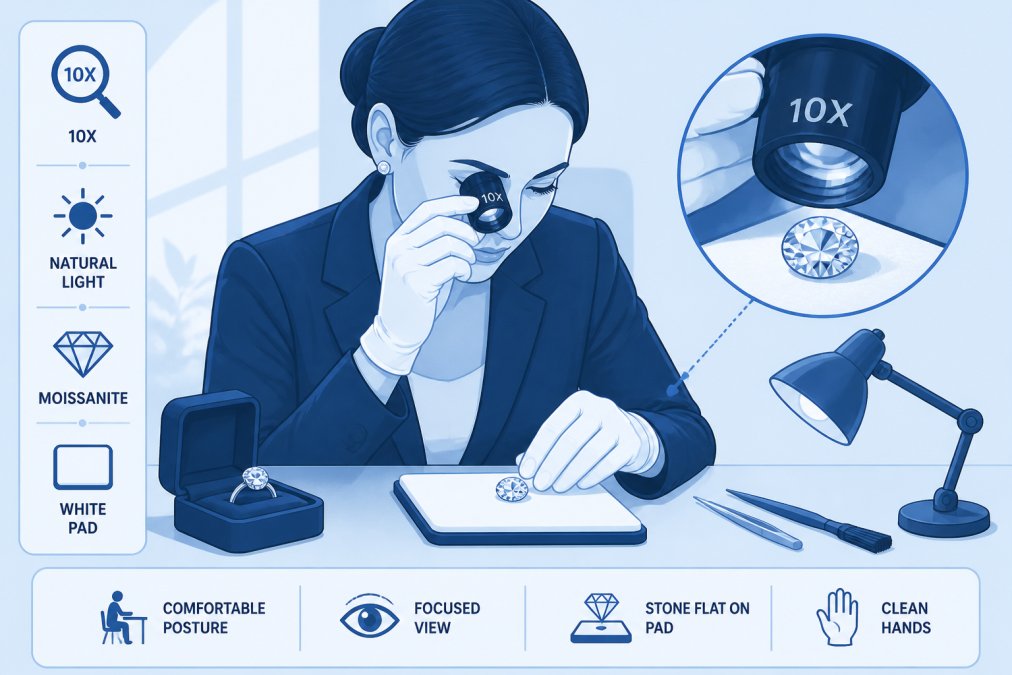
The most direct way to identify high quality moissanite involves hands-on visual inspection using simple tools. A jeweler's loupe and proper lighting are sufficient to assess quality accurately.
Detecting Double Refraction and Birefringence
Double refraction, also called birefringence, is moissanite's most distinctive optical property. Unlike diamonds, moissanite bends light into two rays as it passes through the stone, creating a subtle doubling effect visible at the edges of facets when viewed from certain angles.
High quality moissanite minimizes the appearance of birefringence through superior cut precision. When you look at a well-cut stone, the doubling is barely noticeable or invisible. Lower-quality moissanite shows pronounced doubling, especially along facet junctions near the stone's edges.
To test for birefringence, hold the stone at eye level and look through it toward a light source. Tilt the stone slowly while observing the facet edges. In high quality moissanite, the edges appear sharp and single. In lower-grade stones, you'll see obvious doubling where facet lines appear duplicated or blurred.
Examining Facet Alignment and Symmetry
Facet symmetry directly reflects the precision of the cutting process. High quality moissanite displays perfect alignment where facets meet at consistent angles, creating even sparkle across the entire stone.
Examine the stone under 10x magnification using a loupe. Look at where adjacent facets meet, these junctions should form clean, sharp lines with no visible gaps or misalignment. Poor facet alignment creates uneven light return, making some areas appear brighter or darker than others. Pay special attention to the crown facets (upper area) and pavilion facets (lower area), which must align precisely at the girdle (widest part).
Moissanite Color Grading Scale: What D-F Really Means
The moissanite color grading scale uses the same system as diamonds, with D representing the highest quality and Z indicating heavily tinted stones.
D-color moissanite is completely colorless under all lighting conditions. E-color is near-colorless and virtually indistinguishable from D-color to the naked eye. F-color is also near-colorless and remains an excellent choice, any color tinting is so minimal that only trained gemologists can detect it under magnification.
Below F, color becomes increasingly visible. G and H grades show faint yellow or greenish tints under certain lighting. When shopping for high quality moissanite, stay within the D-F range to ensure premium color quality.
Moissanite vs Diamond Tester: Which Method Works Best
Different testing methods produce different results. Understanding what each tool measures helps you choose the right identification method.
How Thermal Probes and Diamond Testers Identify Moissanite
Thermal conductivity testers, commonly called diamond testers, measure how quickly heat moves through a stone. Diamonds conduct heat at a specific rate that differs from moissanite. The problem is that some moissanite stones fall within the thermal conductivity range that overlaps with diamonds, producing ambiguous results.
Electrical conductivity tests are more reliable. Moissanite conducts electricity differently than diamonds, and electrical testers can detect this distinction with high accuracy. However, most consumer-grade diamond testers use thermal methods.
For practical purposes, thermal testers work reasonably well as a screening tool. If a thermal tester says "moissanite," you can be confident it's moissanite. If it says "diamond," additional testing may be warranted for expensive purchases.
Moissanite Certification and Warranty: Ensuring Authenticity
High quality moissanite should come with a moissanite certification and warranty from a reputable gemological laboratory. The Gemological Institute of America (GIA) and the International Gemological Institute (IGI) both issue moissanite grading reports documenting the stone's color grade, clarity grade, cut quality, and carat weight.
When purchasing high quality moissanite, always request a moissanite certification and warranty. The certificate should include color grade (ideally D-F), clarity grade (ideally VS1 or better), cut grade or cut assessment, carat weight, and gemological laboratory name and date.
A warranty from the retailer should cover manufacturing defects and include terms for cleaning, maintenance, and potential replacement or repair. Life Gets Better offers a curated selection of premium jewelry, including moissanite pieces, and is dedicated to providing quality products that enhance your lifestyle.
Long-Term Durability and Maintenance for High Quality Moissanite
Moissanite ranks 9.25 on the Mohs hardness scale, making it one of the most durable gemstones available. For comparison, diamonds rank 10 and sapphires rank 9. This exceptional hardness means high quality moissanite resists scratching and maintains its optical clarity over decades of wear.
However, durability alone doesn't guarantee long-term beauty. Dust, oils, and debris accumulate on the surface and reduce light transmission. Clean your moissanite monthly using warm soapy water and a soft brush. For deeper cleaning, use an ultrasonic cleaner, moissanite is durable enough to withstand ultrasonic vibrations. Avoid steam cleaning, which can damage the setting.
Inspect the setting periodically to ensure the stone remains secure. With proper maintenance, high quality moissanite maintains its beauty and optical properties indefinitely.
Practical Steps to Evaluate Moissanite Before You Buy
Before purchasing moissanite, follow these systematic steps to ensure you're getting high quality moissanite that meets your expectations.
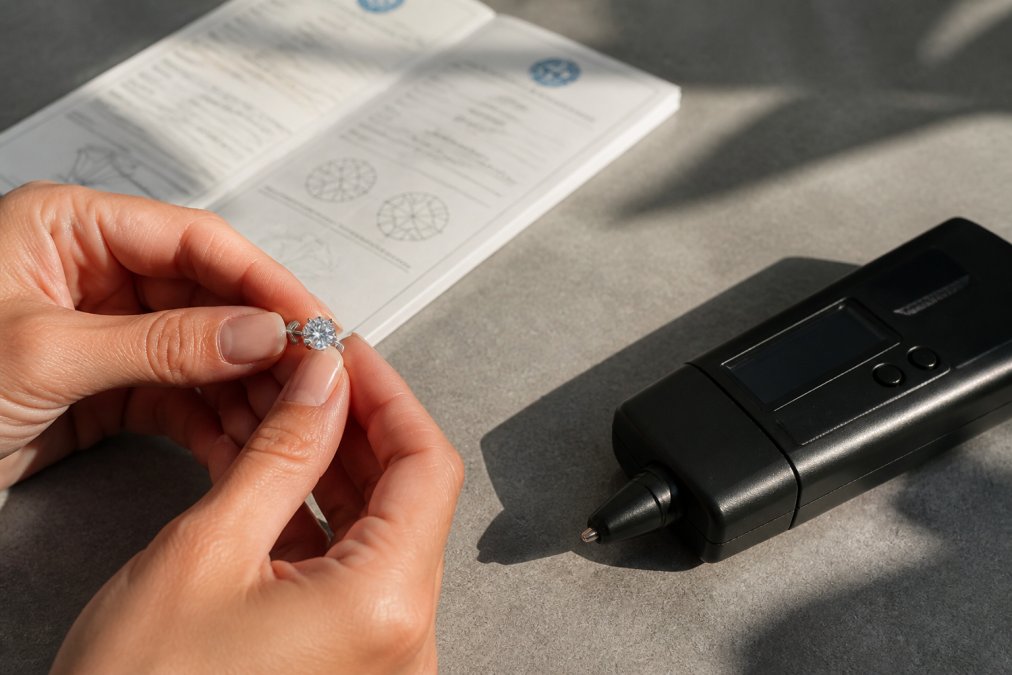
Step 1: Request a Moissanite Certification and Warranty
Demand documentation from a reputable gemological laboratory. If the seller cannot provide a moissanite certification and warranty, the stone's quality is questionable. Legitimate retailers like Life Gets Better offer a curated selection of premium jewelry and are dedicated to providing quality products.
Step 2: Examine Color Under Multiple Lighting Conditions
View the stone under natural daylight, incandescent lighting, and fluorescent lighting. High quality moissanite should remain colorless across all lighting types. If you notice yellow or green tints under any condition, the stone is below D-F grade quality.
Step 3: Use a Jeweler's Loupe to Inspect Facet Alignment
At 10x magnification, examine where facets meet. Look for sharp, clean junctions without gaps or misalignment. Poor alignment indicates lower quality craftsmanship.
Step 4: Test for Birefringence by Tilting the Stone
Hold the stone at eye level and tilt it slowly while observing the facet edges. In high quality moissanite, edges remain sharp and single throughout the motion. Obvious doubling indicates lower quality and poor cut precision.
Step 5: Verify the Stone's Authenticity with a Thermal Tester
Use an electrical or thermal conductivity tester to confirm the stone is moissanite. While not 100% foolproof, this provides an additional quality assurance checkpoint.
Step 6: Compare Against Known High Quality Examples
If possible, examine multiple moissanite stones from different retailers. This comparison reveals the quality differences between premium and lower-grade stones.
Step 7: Review the Return Policy and Warranty Terms
Before finalizing your purchase, understand the retailer's return policy and warranty coverage. Life Gets Better offers free shipping on your orders.
Selecting high quality moissanite requires attention to detail, but the process becomes straightforward once you understand what to evaluate. By assessing cut precision, color grade, clarity, and facet alignment, you can confidently identify stones that deliver exceptional beauty and lasting value. Life Gets Better's curated moissanite collection features only premium D-F color stones with certified quality documentation, ensuring every piece meets the highest standards. Browse our selection of sterling silver moissanite earrings, including the Sterling Silver Everyday Essential CZ Studs and Sterling Silver 8mm CZ Stud Earrings, each crafted with hearts and arrows cut precision for maximum brilliance. Shop with confidence knowing your moissanite investment is backed by certification, warranty protection, and our commitment to quality.
Frequently Asked Questions
How do I tell if moissanite is high quality?
High quality moissanite displays minimal double refraction, excellent facet alignment, and falls within the D-F color grading range. Use a jeweler's loupe to inspect for inclusions and internal flaws, check for a grading report from a recognized lab, and verify the stone's refractive index and brilliance. Authentic moissanite will have consistent sparkle across all facets without visible rainbow effects or cloudy areas when viewed under normal lighting.
What's the difference between moissanite vs diamond tester results?
Diamond testers measure thermal conductivity and electrical properties to distinguish stones. Moissanite conducts heat and electricity differently than diamonds, so thermal probes will identify it as moissanite rather than diamond. High quality moissanite will consistently register as moissanite on these devices. If a stone fails to register clearly or shows inconsistent results, it may indicate lower quality or improper grading, a red flag when shopping.
Why is moissanite certification and warranty important?
Certification from recognized gemological labs (like GIA or AGS) provides third-party verification of the stone's quality, color grade, clarity, and carat weight. A warranty protects your investment against defects, discoloration, or damage. Reputable sellers like Life Gets Better include proper certification with purchases, ensuring you receive exactly what you're paying for and have recourse if the stone doesn't meet stated specifications.
Can I identify high quality moissanite at home?
Yes, using basic tools: a jeweler's loupe (10x magnification) to examine facet symmetry and inclusions, a diamond tester to confirm moissanite composition, and natural lighting to assess color and brilliance. Look for the absence of visible rainbow fire, clear facet junctions, and consistent light return. However, professional grading reports remain the most reliable way to confirm quality metrics like exact color grade and clarity specifications.
This article was written using GrandRanker