
Table of Contents
- How to Spot Unique Jewelry Brands: Key Evaluation Criteria
- Identifying Authentic Hallmarks and Engravings
- Understanding Handmade Jewelry Quality and Craftsmanship
- How to Identify Quality Jewelry Through Materials and Karat Standards
- Evaluating Jewelry Brand Identity and Design Language
- Spotting Emerging Designers and Independent Artisanal Makers
- Price-to-Value Analysis: Recognizing Fair Pricing and Wholesale Markup
- Red Flags in Brand Marketing and Authenticity Claims
Last Updated: August 2, 2026
Learning how to spot unique jewelry brands requires understanding the markers that distinguish authentic, quality pieces from mass-produced alternatives. At Life Gets Better, we've curated a selection of premium jewelry that exemplifies these quality standards, and we're sharing the framework we use to evaluate every piece. Below, we'll walk you through the concrete, actionable criteria that separate truly unique jewelry brands from the rest of the market.
How to Spot Unique Jewelry Brands: Key Evaluation Criteria
Identifying authentic, high-quality jewelry brands starts with understanding that uniqueness operates on multiple levels: design language, production methods, material sourcing, and craftsmanship. The strongest brands typically excel in at least three of these dimensions simultaneously.
Start by examining whether a brand has a coherent aesthetic you can recognize across their entire collection. Unique brands have a point of view; their pieces feel intentional. You should be able to identify a Life Gets Better selection just by looking at it, there's consistency in proportion, finish quality, and design language that signals deliberate creative choices rather than trend-chasing.
Next, investigate the brand's transparency about production methods. Brands that hide their sourcing, manufacturing location, or material specifications are cutting corners. Unique jewelry brands are typically proud of their process and will share details about where pieces are made, who makes them, and why certain techniques matter. This transparency extends to pricing: authentic brands can explain why a piece costs what it does.
Finally, look for evidence of independent curation or decision-making. Do they make their own pieces or collaborate directly with makers? Do they limit production runs? Are they responsive to customer feedback? Unique brands often show signs of real human judgment rather than pure commercial optimization.
Identifying Authentic Hallmarks and Engravings
Hallmarks and engravings are your first line of defense against counterfeit or misrepresented jewelry. These tiny stamps tell you the metal's purity, the maker's identity, and often the year and location of manufacture.
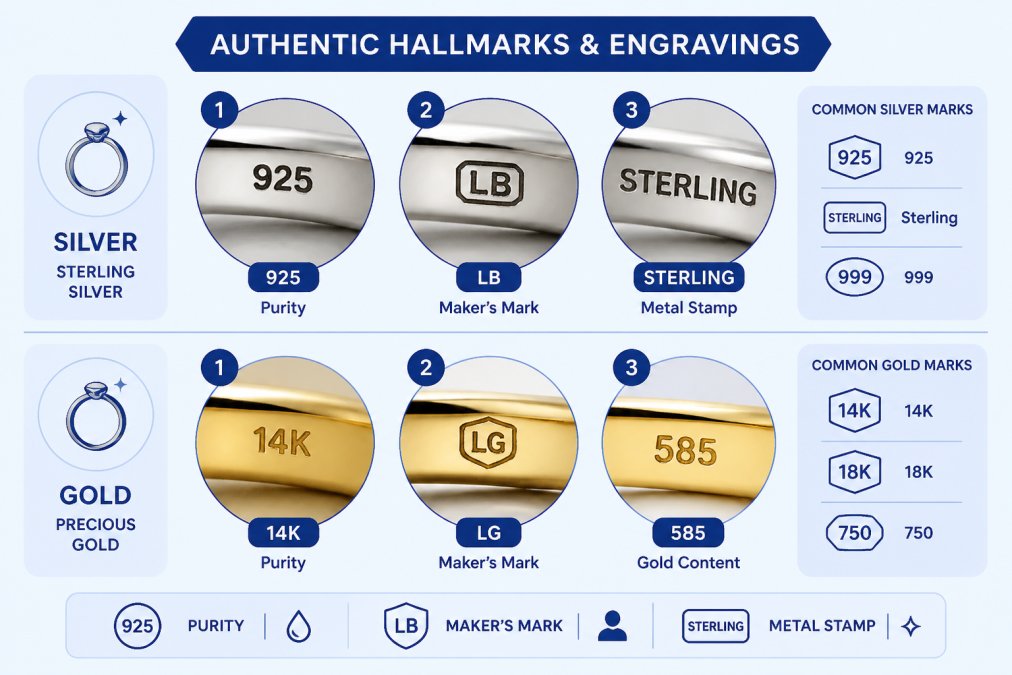
In the United States, federal hallmarking standards require precious metal jewelry to carry purity marks. Sterling silver must be marked 925 (92.5% pure silver). Gold pieces carry marks like 10K, 14K, or 18K indicating karat purity. Platinum is typically marked 950 or 900. If a piece claims to be sterling silver but carries no hallmark, that's a red flag.
Beyond purity marks, authentic pieces often carry maker's marks or designer initials. Independent artisanal makers typically stamp their work with initials or a unique symbol, signaling accountability for quality. Hand-stamped marks from artisanal makers show slight variation, which is actually a sign of authenticity. Machine-stamped marks from mass producers are perfectly uniform.
When examining hallmarks, use magnification. A 10x jeweler's loupe reveals whether marks are crisp and properly applied. Counterfeit hallmarks often appear shallow, inconsistent, or slightly off-center. Authentic marks are struck with precision.
Understanding Handmade Jewelry Quality and Craftsmanship
The term "handmade" is often misused in jewelry marketing. True artisanal jewelry involves human skill at multiple stages: design, material preparation, shaping, finishing, and assembly.
Handmade jewelry shows evidence of the maker's hand throughout the piece. Hand-forged metal shows subtle texture and organic flow that machine-stamped metal cannot replicate. Hand-set stones display slight variations in positioning that reflect careful work rather than mechanical precision.
The hallmark of true craftsmanship is problem-solving. When a maker encounters a challenge, a stone that's slightly irregular, metal that behaves unexpectedly, they adapt, creating unique solutions you won't see repeated identically across multiple pieces. Mass production requires consistency above all else.
Pay attention to finishing details. How are edges beveled? Are they smooth and refined? How is the back of the piece finished? Unique jewelry brands finish the back with the same care as the front because quality is about the whole object. Hand-finished jewelry typically costs more because labor is expensive.
How to Identify Quality Jewelry Through Materials and Karat Standards
Material quality is where many jewelry purchases go wrong. Understanding precious metals and their standards is essential for spotting unique jewelry brands that invest in longevity.
Precious Metals and Purity Marks
Sterling silver (925) is the standard for fine jewelry. It's 92.5% pure silver with 7.5% other metals for durability. Sterling tarnishes over time but polishes clean and develops character with age, this signals authenticity.
Gold purity is measured in karats. 18K gold (75% pure) is the standard for fine jewelry; it's durable enough for daily wear while maintaining high gold content. 14K gold (58.3% pure) is more affordable and slightly more durable. 10K gold (41.7% pure) is the minimum legally defined as gold in the United States.
White gold is yellow gold mixed with white metals and typically rhodium-plated for brightness. Rhodium plating wears off over time, revealing the underlying metal. Quality white gold pieces are designed to look acceptable as the plating wears.
Platinum is the rarest and most durable precious metal. It's naturally white, hypoallergenic, and dense. Platinum jewelry costs significantly more than gold but lasts indefinitely, making it ideal for heirloom pieces.
Gold Vermeil, Sterling Silver, and Demi-Fine Options
Demi-fine jewelry occupies the middle ground between costume jewelry and fine jewelry. It typically uses sterling silver bases with gold vermeil plating or semi-precious stones rather than diamonds. Demi-fine pieces are designed for everyday wear and are more affordable than fine jewelry while maintaining genuine precious metals.
Life Gets Better's collection includes demi-fine pieces for exactly this reason, they deliver authentic materials and design quality at accessible price points. When evaluating demi-fine pieces, check that semi-precious stones are genuine and properly set. Sterling silver should be hallmarked 925. Gold vermeil should be at least 2.5 microns thick (quality brands specify this).
The pricing of demi-fine should reflect its position: more than costume jewelry but less than fine jewelry. If a demi-fine piece costs as much as solid gold, the brand is overpricing. If it costs as much as costume jewelry, the materials are likely compromised.
Evaluating Jewelry Brand Identity and Design Language
A unique jewelry brand has a recognizable design language, a consistent approach to proportion, ornamentation, and aesthetic that makes their work identifiable. This consistency signals creative vision rather than trend-chasing.
Examine how a brand approaches classic forms. Do they reinterpret traditional designs with a fresh perspective? Unique brands often take something familiar and shift it slightly, making a signet ring more sculptural or a pendant more architectural. These shifts reveal creative thinking.
Look at how materials are showcased. Does the brand highlight the natural beauty of metals and stones, or obscure it with heavy plating? Authentic brands trust their materials. They let silver show as silver, let gold show as gold.
Consider the brand's approach to color and negative space. Do they work in a specific palette? Do they leave breathing room in designs? Minimalist design requires confidence, you can't hide weak proportions or poor craftsmanship with ornamentation. Brands that embrace negative space are typically confident in their fundamental design skills.
Spotting Emerging Designers and Independent Artisanal Makers
Emerging designers and independent artisanal makers represent the cutting edge of unique jewelry. These creators often have limited distribution, making their work feel exclusive and rare.
Independent makers typically sell through their own websites, craft fairs, Instagram, or curated platforms specializing in artisanal work. They rarely appear in department stores. This limited distribution is intentional, allowing them to maintain quality control and pricing integrity.
The best emerging designers share several characteristics: they're transparent about their process, responsive to customers, and selective about their output. Look for makers who have developed a distinctive technique or material approach. This specialization signals expertise.
Pay attention to how emerging designers price their work. Fair pricing reflects realistic material and labor costs. If they're significantly underpricing compared to established brands doing similar work, they may be undervaluing themselves or using lower-quality materials.
Price-to-Value Analysis: Recognizing Fair Pricing and Wholesale Markup
Understanding jewelry pricing is crucial for spotting unique brands and avoiding overpriced mediocrity. The typical retail markup for jewelry is 100-300%. A piece that costs a brand $100 to produce might retail for $300-$400.
Direct-to-consumer brands, those selling primarily through their own websites, typically operate with lower markups (50-150%) because they eliminate middlemen. This is one reason why buying directly from emerging designers often offers better value.
Calculate material value as a baseline. Sterling silver costs roughly $0.60-$0.80 per gram. A 5-gram sterling silver ring contains about $3-$4 in material. If that ring retails for $25, the markup is reasonable. If it retails for $200, either the craftsmanship is exceptional or the brand is overpriced.
For gold, check current prices online and estimate the piece's weight. An 18K gold ring weighing 4 grams contains about 3 grams of pure gold, roughly $150-$180 in material at current prices. A retail price of $400-$500 reflects a reasonable markup.
The most reliable way to evaluate pricing is comparison shopping. Look at pieces of similar quality, materials, and complexity from multiple brands. If one brand consistently prices 30-50% higher than comparable alternatives without obvious superiority, they're likely overpriced.
Red Flags in Brand Marketing and Authenticity Claims
Certain marketing patterns should trigger skepticism. Vague claims about materials are a major red flag. Phrases like "premium metals" or "luxury materials" mean nothing without specifics. Authentic brands state exactly what they use: "18K gold," "sterling silver," "lab-grown diamonds."
Overuse of superlatives without supporting evidence is another warning sign. Unique brands let their work speak for itself. They might say "hand-forged in our studio" or "limited to 50 pieces per season," but they don't resort to empty superlatives.
Influencer-heavy marketing with no substantive brand story is suspicious. If a brand's entire marketing strategy is paying influencers to wear their pieces, they're likely relying on trend-chasing rather than design quality.
Pressure to buy quickly ("limited stock," "this price ends today") is a classic manipulation tactic. Unique brands with genuine limited production don't need artificial scarcity.
Claims about sustainability or ethical sourcing without third-party verification are increasingly common. Authentic sustainable brands can point to specific suppliers, certifications, or verifiable practices. They're transparent about their supply chain.
Fake customer reviews are a growing problem. Authentic reviews mention specific details and sometimes include minor criticisms. Fake reviews are uniformly glowing and generic. Check review dates; a flood of reviews all posted within a few days is suspicious.
Finally, be wary of brands that don't allow returns or have unusually restrictive return policies. Unique jewelry brands that stand behind their quality offer reasonable return windows (typically 30 days).
Finding truly unique jewelry brands requires looking beyond marketing claims to examine materials, craftsmanship, design philosophy, and pricing integrity. The framework we've covered, evaluating hallmarks, understanding materials, assessing design language, and recognizing red flags, gives you the tools to make confident purchases. Life Gets Better curates jewelry that meets these rigorous standards, featuring pieces from emerging designers and established makers who prioritize quality and authenticity over trend-chasing. When you shop with us, every piece has been evaluated against the same criteria you've learned here.
| Evaluation Criteria | What to Look For | Red Flag |
|---|---|---|
| Hallmarks & Engravings | Clear, crisp purity marks (925, 14K, etc.); maker's initials or symbols | Missing hallmarks; shallow or misaligned marks |
| Materials | Specific metal types stated (sterling silver, 18K gold, platinum); thickness specs for vermeil | Vague terms like "premium" or "luxury"; no material details |
| Craftsmanship | Evidence of hand-finishing; visible quality in detail work; finished back surfaces | Rough edges; unfinished backs; inconsistent quality |
| Design Language | Recognizable aesthetic across collection; intentional proportion and ornamentation | Generic designs; trend-chasing; no coherent style |
| Pricing | Fair markup reflecting materials and labor; transparent cost breakdown | Significantly higher than comparable quality; artificial urgency tactics |
| Brand Transparency | Clear sourcing information; responsive customer service; documented production methods | Vague claims; evasive answers; influencer-only marketing |
Frequently Asked Questions
What are the main differences between demi-fine and fine jewelry, and how does this affect quality?
Demi-fine jewelry uses lower precious metal content (typically gold vermeil or plated pieces) compared to fine jewelry, which contains solid precious metals. Demi-fine pieces cost less but may not last as long with daily wear. Fine jewelry holds value better and resists tarnishing longer. Your choice depends on budget and wear frequency. For everyday pieces you'll wear constantly, fine jewelry offers better longevity. For statement pieces worn occasionally, demi-fine provides quality aesthetics at lower cost.
How can I verify that a jewelry brand's ethical sourcing and sustainability claims are genuine?
Look for third-party certifications like Responsible Jewellery Council (RJC) certification or fair trade designations. Check if the brand discloses their supply chain publicly and names their material sources. Request documentation of their sourcing practices. Authentic brands provide detailed information about where metals and gemstones originate. Be skeptical of vague sustainability language without supporting certifications or verifiable supplier information. Contact the brand directly and ask specific questions about their sourcing process and production methods.
What digital tools can I use to verify jewelry authenticity and brand provenance?
Some brands now offer blockchain-based certificates of authenticity that you can verify online. Check the brand's official website for serial number lookup tools. Use reverse image searches to verify that product photos match authentic listings. Cross-reference hallmarks with official hallmarking standards databases maintained by assay offices. Contact independent jewelry appraisers who can verify authenticity using specialized equipment. Review the brand's return and authentication policy before purchasing.
How do I recognize when a jewelry brand uses mass-produced designs versus bespoke or small-batch pieces?
Bespoke and small-batch pieces show hand-finished details like slight variations in surface texture or minor asymmetries that indicate human craftsmanship. Mass-produced jewelry appears identical across multiple pieces with perfect uniformity. Check if the brand offers customization or limited production runs. Independent designers typically produce fewer than 50 pieces per design. Review product descriptions for mentions of handmade, artisanal, or limited-batch production. Ask the brand directly about their production methods and batch sizes to understand their manufacturing scale.
This article was written using GrandRanker