
Table of Contents
- Moissanite vs Diamond: Quick Comparison Table
- What Is Moissanite?
- Moissanite vs Diamond Durability: Hardness and Long-Term Wear
- Brilliance, Fire, and Optical Characteristics
- Moissanite Price Comparison: Cost Breakdown and Value
- How to Clean Moissanite Jewelry and Prevent Clouding
- Ethical Sourcing, Resale Value, and Long-Term Considerations
- Conclusion: Why Moissanite Makes Sense for Your Jewelry
Last Updated: August 19, 2026
Moissanite vs Diamond: Quick Comparison Table
When deciding between moissanite and diamond jewelry, the choice comes down to what matters most: brilliance, durability, cost, or ethical sourcing. Moissanite has become a serious contender in the fine jewelry market, winning on value and long-term practicality for many buyers.
| Attribute | Moissanite | Diamond | Winner |
|---|---|---|---|
| Hardness (Mohs Scale) | 9.25 | 10 | Diamond (slightly) |
| Refractive Index (Brilliance) | 2.65-2.69 | 2.42 | Moissanite |
| Fire (Color Dispersion) | High (visible rainbow) | Low (subtle) | Moissanite |
| Color Grade | D, E, F (colorless) | D-Z scale | Diamond (wider range) |
| Price (1 carat equivalent) | $10.99-$85.60 | $2,000-$15,000+ | Moissanite |
| Durability (10-year outlook) | Excellent | Excellent | Tie |
| Ethical Sourcing | Lab-grown (100% ethical) | Mixed (conflict concerns) | Moissanite |
| Resale Value | 20-30% of original | 30-50% of original | Diamond |
| Maintenance | Simple cleaning, occasional clouding | Simple cleaning | Tie |
Moissanite wins on affordability and optical performance, while diamonds hold value better and avoid the visible rainbow sparkle some find excessive. For engagement rings and everyday wear, moissanite delivers luxury appearance at a fraction of the cost.
What Is Moissanite?
Moissanite is a lab-created gemstone made from silicon carbide, engineered to mimic diamond's optical and physical properties. Unlike cubic zirconia, which clouds over time, moissanite maintains its brilliance for decades. First discovered in meteorites in 1893, modern moissanite for jewelry has been manufactured since the 1990s.
Moissanite is not a "fake diamond", it's a distinct gemstone with its own optical characteristics. A trained gemologist can identify it, but to the naked eye, it delivers comparable sparkle at a radically different price point.
Life Gets Better offers moissanite jewelry emphasizing this transparency. Their VVS1 Moissanite Stud Earrings and 2 Carat D Color Moissanite Stud Earrings are crafted in 925 sterling silver and designed for daily wear.
On the Mohs hardness scale, moissanite scores 9.25, just below diamond's 10. For practical purposes, this means excellent scratch resistance and polish retention through years of wear. The synthetic nature also means zero ethical concerns and no environmental damage from mining.
Moissanite vs Diamond Durability: Hardness and Long-Term Wear
Both materials survive daily wear for decades, but they behave differently under stress. Diamond ranks 10 on the Mohs hardness scale; moissanite ranks 9.25. While diamond is harder, the difference is marginal for jewelry purposes, both resist scratching from everyday contact.
The real durability question is toughness, which measures resistance to fracturing under impact. Moissanite's silicon carbide structure makes it more resistant to sudden impacts than diamond, which can crack internally from hard blows. For a ring worn daily for 10 years, moissanite's toughness advantage is meaningful.
Over 5-10 years, both stones maintain optical clarity with proper care. Diamond facet edges can chip more easily than moissanite edges under repeated contact, particularly relevant for engagement rings. A diamond solitaire might develop tiny edge chips after five years; a moissanite equivalent typically shows no edge wear.
Diamonds hold resale value better, typically 30-50% of original purchase price. Moissanite resells for 20-30% of original cost, partly because supply is unlimited. If buying for long-term investment rather than enjoyment, diamond wins this metric.
Brilliance, Fire, and Optical Characteristics
Moissanite and diamond diverge most dramatically in optical performance. Both are brilliant, but they reflect light differently.
Brilliance measures how much light bounces back through the stone. Moissanite's refractive index is 2.65-2.69 compared to diamond's 2.42. Higher refractive index means more light reflection, so moissanite appears more brilliant than diamond in bright light.
Fire is the rainbow effect created when light splits into its color spectrum. Diamond has low fire with subtle rainbow flashes in bright sunlight. Moissanite has high fire with visible rainbow effects even in normal indoor light. This is the most distinctive visual difference.
Scintillation is the sparkle pattern created by facet arrangement. Moissanite's higher refractive index means more pronounced sparkle.
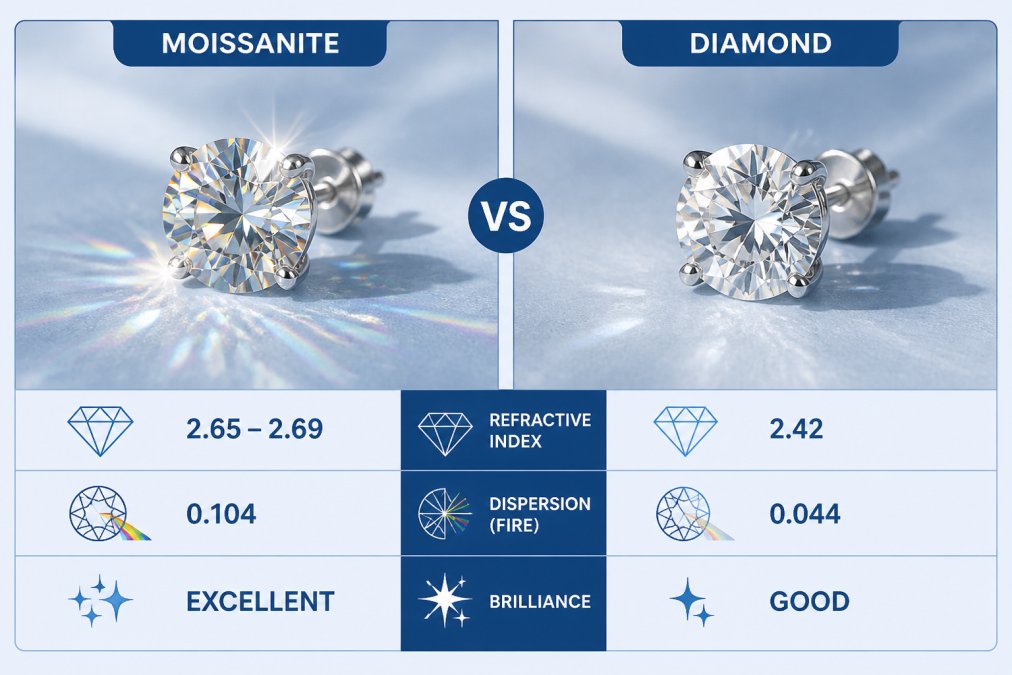
If you want visibly sparkly stones that catch light obviously, moissanite wins. If you prefer diamond's understated brilliance, moissanite's high fire might feel excessive. This is subjective.
Life Gets Better's Princess Cut Moissanite Stud Earrings and 1ct D Color Moissanite Square Stud Earrings showcase this optical characteristic. The cuts maximize the fire and brilliance moissanite is known for.
Color grading works similarly for both stones on the D-Z scale, where D is colorless. High-quality moissanite is graded D or E, meaning truly colorless. Lower-grade moissanite can show slight yellow or greenish tints in larger stones. If you buy D or E moissanite, you're getting a colorless stone indistinguishable from colorless diamond in terms of color.
Moissanite Price Comparison: Cost Breakdown and Value
Moissanite wins decisively on price. A 1-carat diamond of decent quality (VS1 clarity, H color) costs $3,000-$8,000. A 2-carat diamond runs $8,000-$20,000.
Life Gets Better's moissanite pieces start at $10.99 for VVS1 clarity stud earrings, scaling to $85.60 for premium pieces like the 1 Carat 925 Sterling Silver Moissanite Earrings. Even premium moissanite is a fraction of diamond pricing.
The difference stems from supply and demand. Diamonds are rare natural stones with controlled supply. Moissanite is lab-manufactured with unlimited supply, eliminating scarcity premiums.
For engagement rings, the math is stark. A 1.5-carat moissanite solitaire ring in 925 sterling silver costs $50-$150. The equivalent diamond ring costs $5,000-$12,000. You're paying 50-100x more for diamond with subtle visual differences unless examining the fire effect closely.
Moissanite delivers 90% of visual impact at 2-5% of the cost. For buyers wanting luxury appearance without investment burden, moissanite is the rational choice.
Resale value is the caveat. Diamonds resell for 30-50% of original price; moissanite for 20-30%. But since moissanite costs far less upfront, you're still ahead financially. A $100 moissanite stone reselling for $20 represents better value than a $5,000 diamond reselling for $2,000, assuming enjoyment rather than investment is your goal.
How to Clean Moissanite Jewelry and Prevent Clouding
Moissanite requires the same basic cleaning as diamond, with one critical difference: it's prone to clouding without proper maintenance.
Clouding occurs when soap residue, lotion, and mineral deposits accumulate on the stone's surface, creating a hazy film that dulls sparkle. It's not permanent damage, just surface contamination requiring regular cleaning.
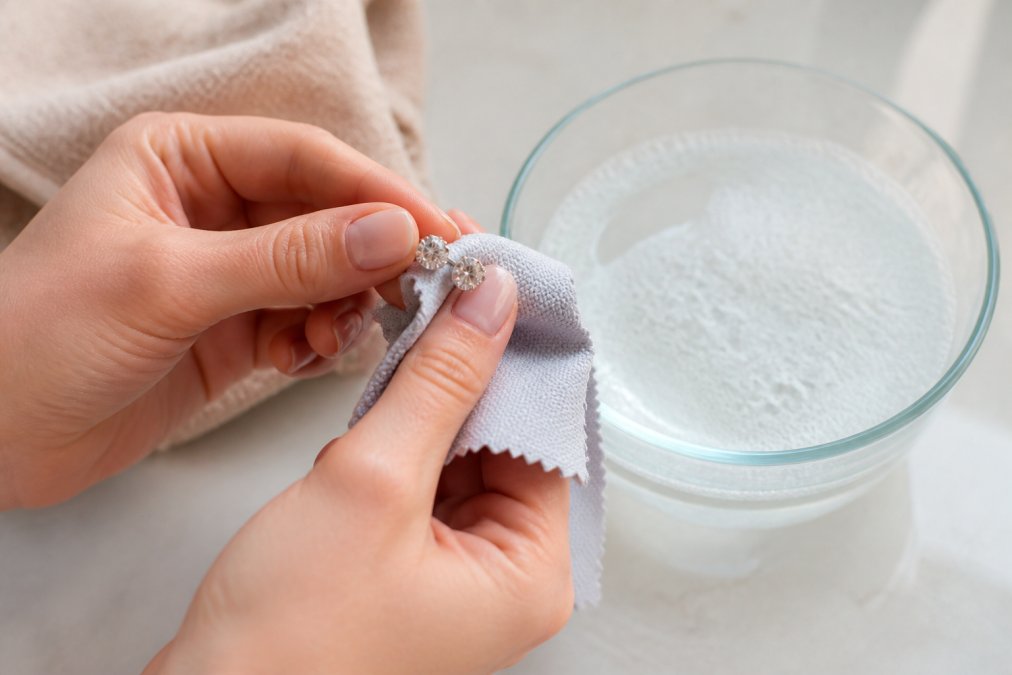
Use warm water, mild dish soap, and a soft lint-free cloth. Soak earrings for 5-10 minutes, then gently wipe. Dry thoroughly before wearing. For deeper cleaning, use a soft-bristled toothbrush to gently scrub around the setting and facets.
Avoid ultrasonic and steam cleaners, which can damage settings and loosen stones. Stick to hand cleaning.
Remove moissanite jewelry before showering, swimming, or applying lotions and perfumes, which create buildup causing clouding. Store in a dry place, ideally in the original box or pouch. Exposure to air and moisture accelerates sterling silver tarnishing.
Life Gets Better's moissanite pieces come with storage bags and care instructions. Following these guidelines keeps stones brilliant for years. If clouding develops, soaking and cleaning restores sparkle. This is moissanite's trade-off, it requires slightly more attention than diamond, but maintenance is easy and free.
Ethical Sourcing, Resale Value, and Long-Term Considerations
Moissanite's ethical advantage is absolute. Every stone is lab-created, meaning zero environmental damage from mining and zero conflict diamond risk. If ethical sourcing matters, moissanite is the clear choice.
Diamond mining has documented environmental and human rights concerns. While "conflict-free" diamonds and certification systems like the Kimberley Process exist, mining still carries significant environmental impact. Moissanite sidesteps all this, it's lab-created with no mining required.
Resale value is where moissanite falls short. Diamonds resell for 30-50% of original price; moissanite for 20-30%. This gap exists because diamonds have a mature, liquid secondhand market with established pricing. Moissanite's secondhand market is smaller and less developed.
However, this matters less than it sounds. A $100 moissanite stone reselling for $20 loses $80. A $5,000 diamond reselling for $2,000 loses $3,000. Absolute loss is much higher with diamond despite lower percentage loss.
Insurance and appraisal present challenges. Moissanite is harder to insure because insurers struggle to value it. Most policies require appraisals, and appraisers often undervalue moissanite due to lack of established market pricing. A $10,000 diamond ring is easy to insure for that value; a $100 moissanite ring might insure for $50-$75.
This isn't major for affordable Life Gets Better pieces. The VVS1 and D color earrings cost so little that insurance is often unnecessary. But for high-end moissanite engagement rings, appraisal and insurance can be frustrating.
Both moissanite and diamond can be set in any metal. Life Gets Better uses 925 sterling silver, which is durable and affordable. Any jeweler can reset a moissanite stone into different metal or settings without damage.
Long-term outlook: moissanite holds up beautifully for 10-20 years of daily wear. It won't cloud permanently, scratch noticeably, or lose its fire. The setting might need maintenance, sterling silver can tarnish and prongs might need retightening, but the stone itself is essentially permanent.
Conclusion: Why Moissanite Makes Sense for Your Jewelry
The choice between moissanite and diamond depends on your priorities. If you value affordability, ethical sourcing, and visible sparkle, moissanite is the obvious winner. If you prioritize resale value and diamond's subtle brilliance, diamond remains the traditional choice.
For most buyers, particularly those under 40, gift-givers, and anyone wanting luxury appearance without financial burden, moissanite is the smarter option. You get 90% of visual impact at 2-5% of the cost, with the added benefit of ethically lab-created stones.
Life Gets Better's moissanite collection offers quality pieces at accessible prices. Their 925 sterling silver settings are durable and hypoallergenic, and pieces are designed for daily wear. The 2 Carat 8.0mm D Color Moissanite Stud Earrings deliver moissanite's brilliance and fire at prices making luxury jewelry genuinely accessible.
Start with moissanite. Enjoy the sparkle. Clean regularly to prevent clouding. In 5-10 years, you'll have a piece as brilliant as the day you bought it, spent a fraction of what diamond would have cost.
Choosing the right gemstone shouldn't require choosing between beauty and affordability. Moissanite solves that dilemma by delivering exceptional brilliance and durability without diamond's premium price tag. Life Gets Better's moissanite jewelry, featuring VVS1 clarity grading, 925 sterling silver settings, and free shipping, makes it easy to own luxury pieces reflecting your personal style. Explore Life Gets Better's moissanite collection and discover why thousands of buyers are choosing moissanite for engagement rings, earrings, and everyday wear.
Frequently Asked Questions
What is the main downside of moissanite compared to diamonds?
Moissanite has a higher refractive index than diamonds, which means it shows more rainbow fire and sparkle. Some people view this as a strength, while others prefer the subtler sparkle of diamonds. Additionally, moissanite can develop a hazy coating over time if not cleaned regularly, though this is easily reversible with proper maintenance. Unlike diamonds, moissanite has no resale value, you're buying it for personal wear, not as an investment.
Is moissanite a good choice for an everyday engagement ring?
Yes, moissanite is excellent for everyday engagement rings. It ranks 9.25 on the Mohs hardness scale, making it second only to diamonds and far more durable than cubic zirconia or other gemstones. It resists scratching and maintains its clarity through daily wear. The main consideration is the noticeable sparkle and fire, if you prefer a more understated look, moissanite may be too brilliant for your taste. Otherwise, it's a practical, affordable choice that lasts a lifetime.
How does moissanite price compare to diamond jewelry?
Moissanite costs significantly less than diamonds of comparable size and clarity. For example, Life Gets Better offers VVS1 moissanite stud earrings starting at $10.99, while a 1 carat 925 sterling silver moissanite pair is $85.60. A natural diamond of similar quality and carat weight would cost hundreds to thousands of dollars. You get nearly identical visual brilliance at a fraction of the price, making moissanite a smart value choice for high-quality jewelry.
Can I tell the difference between moissanite and diamond with the naked eye?
Most people cannot tell the difference without close inspection. The main visual difference is moissanite's stronger rainbow sparkle (fire and scintillation), which some find more striking than a diamond's subtler brilliance. A trained gemologist using specialized equipment can distinguish them. If you're concerned about the stone's origin or want certification, moissanite comes with a GDTC certificate confirming its properties, something that adds confidence and transparency to your purchase.
How do I clean moissanite jewelry to prevent clouding?
Clean moissanite regularly with a soft, lint-free cloth to remove oils and dust that can cause cloudiness. For deeper cleaning, use mild soap and warm water, then dry thoroughly. Avoid harsh chemicals and abrasive materials. Store your moissanite jewelry in a dry place away from moisture and air exposure to slow tarnishing of the sterling silver setting. Regular maintenance prevents the hazy buildup that can occur over time, keeping your pieces sparkling for years.
This article was written using GrandRanker